Build world-changing ideas with AI, one year at a time.
AI for Youth Academy is a five-year journey for middle and high school innovators. Build foundational math, programming, and machine learning intuition, then apply it in a capstone project with guidance from mentors and college ambassadors.
Four years of foundations plus a capstone project year.
Mentor Network
College ambassadors and industry coaches in every cohort.
Future Focused
Ethics, creativity, and impact baked into every project milestone.
Why This Academy
A small extracurricular circle for standout students who want to geek out, go deeper, and build projects way beyond the usual curriculum.
Our Guiding Beliefs
Three principles shape every AI for Youth session
01
Hands-on practice beats theory alone.
Middle schoolers grasp AI faster when they build, train, and test real models.
02
Early foundations unlock high school opportunities.
Students who understand AI before eleventh grade are ready to lead clubs, volunteer on tech initiatives, or launch bold ideas.
03
Self-motivated learners thrive.
Complex topics stick when students own their learning journey and stretch further with mentor support.
Five-year roadmap
A five-year plan built for intuitive understanding.
Thanks for your trust; welcome to the journey. Over the next four years students build foundations in math, programming, machine learning, and neural networks. These topics sound graduate-level, so we focus on core ideas without formal derivations. Year 5 is a project capstone that applies the full stack.
Year 1
Year 1 · 2D Math + Python Foundations
2D vectors, matrix representations, and beginner Python
Spring term core foundations
Students build intuition for 2D space, matrix representations of vectors, and linear equations while learning Python basics through FIRST LEGO Challenge robotics.
Key themes
2D space, points, vectors, and matrix representations
2D representations of linear equations on a map
Python fundamentals: functions, loops, and conditionals
Hands-on moments
Program a FIRST LEGO Challenge robot car to navigate a 2D map.
Use the FIRST LEGO Python library and function calls to control movement.
Practice loops and if/else logic to make navigation reliable.
Tools
Python
FIRST LEGO Python library
FIRST LEGO Challenge field
What students walk away with
Explain vectors and linear equations with 2D map examples.
Write beginner Python programs using functions, loops, and conditionals.
Connect robot movement to 2D math representations.
Coding agent setup, app development, and team collaboration
Project-based learning across three semesters
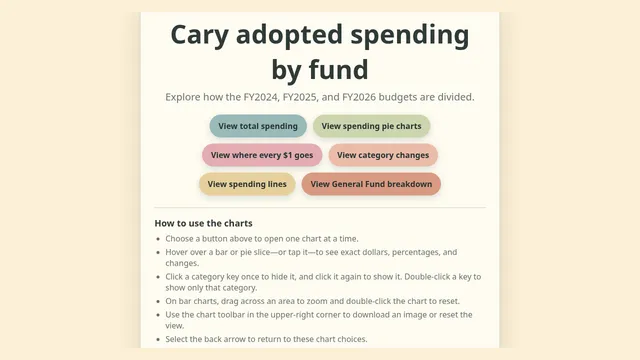
Students make a coding agent their everyday build partner, develop real applications with it, and learn to work as a team from the first commit to a live site. Projects use real data, such as the Town of Cary budget, and ship through GitHub.
Key themes
Coding agent setup: describe what you want clearly and review what it writes
App development: HTML, CSS, JavaScript, and Python with real data
Team collaboration: Git and GitHub with branches, pull requests, and code review
Hands-on moments
Set up a coding agent and build your first page with it.
Turn a real dataset into an interactive web app and deploy it.
Work in a shared GitHub repository and review each other's changes.
Tools
Claude Code / Codex
Git & GitHub
HTML/CSS/JS
Python
What students walk away with
Direct a coding agent with clear, testable instructions and check its work.
Build and deploy a web application that other people can use.
Collaborate in a team with Git without stepping on each other's work.
Students move into 3D space, 2D projection, and linear algebra basics while exploring dimensionality reduction and unsupervised learning. They also build classification models with scikit-learn using the MNIST dataset.
Key themes
3D space, 2D projection, and linear algebra basics
Dimensionality reduction and k-means clustering
Classification models, including an intro to SVMs
Hands-on moments
Project 3D points into 2D and interpret spatial relationships.
Run k-means clustering on image embeddings or numeric datasets.
Train scikit-learn classifiers on the MNIST dataset.
Tools
Python
NumPy
scikit-learn
MNIST
What students walk away with
Describe when to use supervised vs. unsupervised methods.
Apply dimensionality reduction and k-means to real data.
Build and evaluate a classifier with scikit-learn.
Studio SeriesUnsupervised learning and classification labs.
Year 4
Year 4 · Deep Learning & Foundation Models
CNNs, fine-tuning, and modern model stacks
Year 4 advanced studio
Students build pre-calc graph intuition, then dive into CNN structure, fine-tuning workflows, and foundation model applications. Programming includes AI-assisted PyTorch work and an optional transformer overview if time allows.
Key themes
Pre-calc graph intuition for model behavior
CNN architecture, fine-tuning, and applied use cases
Foundation models and an optional transformer overview
Hands-on moments
Fine-tune a CNN on a small custom dataset.
Use AI-assisted tools to accelerate PyTorch coding and debugging.
Explore a lightweight transformer demo if time allows.
Tools
PyTorch
Pre-calc graphing tools
AI coding assistants
What students walk away with
Explain CNN structure and why fine-tuning works.
Apply a foundation model to a targeted task.
Use AI-assisted workflows to iterate faster and document choices.
Advanced StudioDeep learning labs with CNNs and fine-tuning.
Year 5
Year 5 · Capstone Project
Build a complete project from idea to demo
Project year
Students plan and deliver a full AI project, combining math intuition, ML workflows, and neural network tools into a real-world prototype.
Key themes
Problem framing and project planning
Dataset selection, model choice, and iteration
Communication, ethics, and final demo
Hands-on moments
Define a capstone scope with mentor feedback.
Build, test, and refine an end-to-end prototype.
Share results through a showcase, report, or demo.
Tools
Student-chosen tool stack
Python
Presentation tools
What students walk away with
Deliver a working AI project with clear documentation.
Justify model choices and trade-offs.
Create a portfolio-ready showcase artifact.
Capstone StudioMentor-guided project cycle.
Learning experiences
Designed for curious creators who learn by doing.
Whether summer camps or weekend studios, every cohort blends collaborative play, rapid prototyping, and real-world mentorship. Students build confidence and community while solving meaningful problems.
Studio-powered summer camps
Choose immersive week-long or multi-week camps that mix morning deep-dives with afternoon build sessions. Showcase nights bring families, educators, and community partners together to celebrate progress.
Daily design sprints and lightning talks from guest mentors
Hands-on labs with maker kits, cameras, and edge AI devices
Reflective journals and demo booths to document growth
After school & weekend labs
Weekly meetups keep the momentum going during the school year. Teams plan, prototype, and iterate with guidance from college ambassadors and industry coaches.
Community-centered problem statements sourced from partners
Peer code reviews and showcase standups every other week
Pathway badges that recognize technical and leadership growth
Featured
Mentor moments & future pathways
Students meet researchers, designers, and entrepreneurs who apply AI responsibly. Alumni get early access to internships, hackathons, and paid teaching-fellow roles.
Portfolio coaching and college-ready recommendation letters
Connections to national AI competitions and showcase events
Alumni network with year-round learning and leadership opportunities
Project showcase
Real things our students have built and shipped.
Every project here was designed, coded, and deployed by students. Explore their live work.
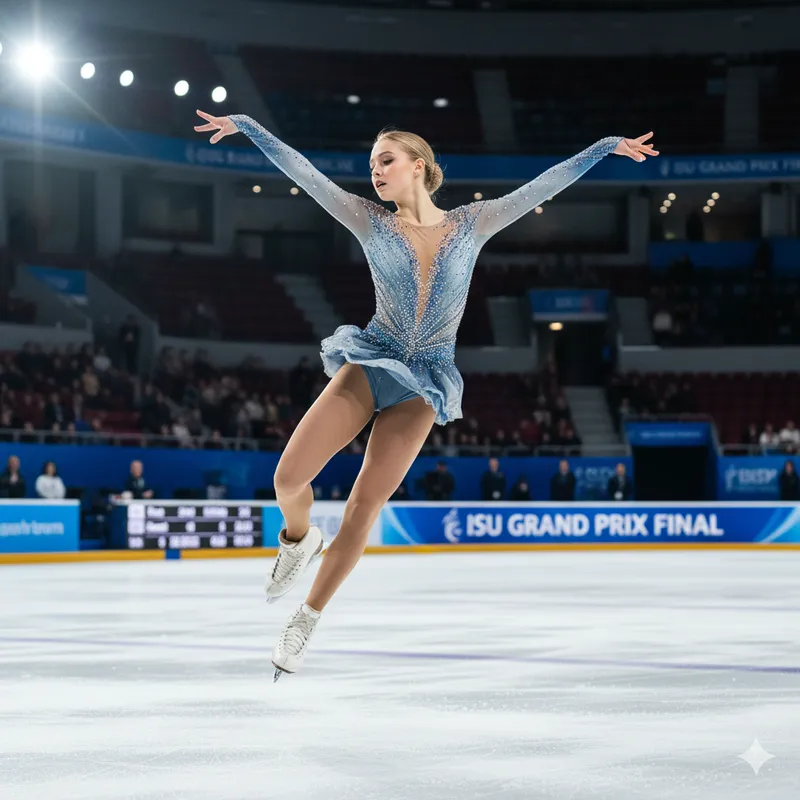
We run two parallel tracks with the same five-year pacing. Years 1-2 are a shared core foundation. Starting in Year 3, students choose a volleyball or figure skating focus for projects and datasets.
Track A
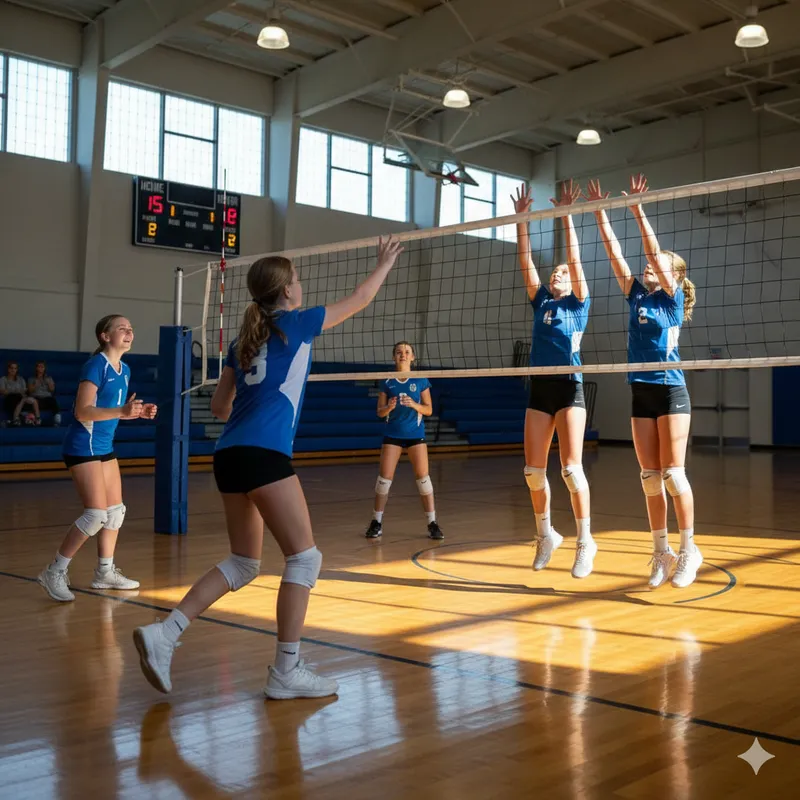
Volleyball Focus Track
Theme: Volleyball (introduced in Year 3)
A shared Year 1-2 core covers math, Python, and supervised learning. Starting in Year 3, projects and datasets focus on volleyball movement, gameplay, and team insights.
A shared Year 1-2 core covers math, Python, and supervised learning. Starting in Year 3, projects and datasets focus on figure skating movement, choreography, and performance insights.
Seats are limited and selection is highly competitive. Share your details to receive the program guide and get notified when enrollment opens. Students who are exploring on their own are always welcome to follow our self-paced study guides while they wait.